Text-to-workflow cuts engineers' tedious task time to seconds with Agentic AI platform
Synera's graph-based engineering platform now generates complex workflows in under 3 minutes using an Agentic AI agent — down from up to 2 hours of manual work, with zero hallucinations.


Synera operates an AI agent platform for engineering, integrating with popular CAD, CAE and PLM software. Their agents and automations accelerate product development by up to 10 times through workflow complexity reduction and automation.
Over 100,000 workflows have been created by companies including NASA, Airbus, BMW, Hyundai, and Henkel.
- Industry
- Manufacturing / IT
- Headquarters
- Bremen, Germany
- Company size
- 51–200 employees worldwide
- Founded
- 2018
- Notable clients
- NASA, Airbus, BMW, Hyundai, Henkel
The challenges of creating a text-to-workflow agent that delivers
Synera is versatile and powerful, letting engineers and specialists build traditional and agentic AI automations for their processes. Its graph-based workflow editor connects nodes representing different operations — from data retrieval to CAD transformations — into coherent, repeatable pipelines.
The problem: building complex workflows requires deep platform knowledge and significant time investment. Engineers can spend up to two hours constructing a single advanced workflow from scratch. Synera's team needed a way to let users describe what they want in plain language and have the platform generate the workflow automatically — without hallucinating nodes that don't exist or producing structurally invalid graphs.
The technical complexity was substantial. Synera's node library is proprietary; no pre-trained model had seen it. The solution required a custom dataset, a fine-tuned model, a validation mechanism capable of catching LLM over-engineering tendencies, and a RAG system to keep generation grounded in real examples.
How the language converts to nodes (and back)
To make text-to-workflow possible, Synera's team first created an interpreter to describe nodes in a pseudo-Python representation — a structured, human-readable format that captures each node's type, parameters, and connections without losing the graph's topology.
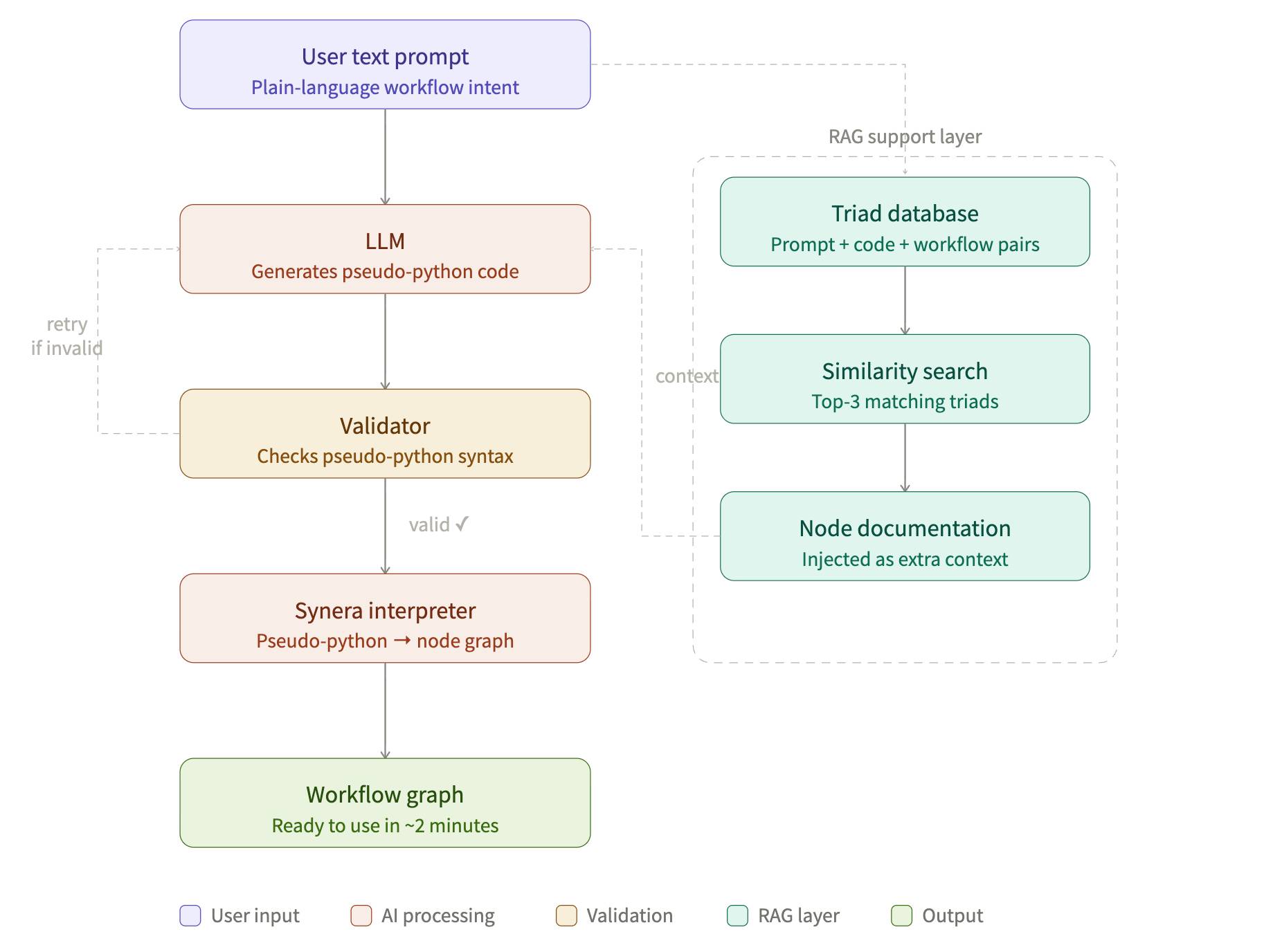
This representation becomes the bridge: the LLM receives the user's natural-language prompt and generates pseudo-Python code describing the desired workflow. Synera's interpreter then converts that code back into a valid visual graph of connected nodes — ready to execute.
Building a dataset from scratch
Data scarcity is a challenge in nearly every Artificial Intelligence project — and Synera was no exception. No public dataset existed for a proprietary node library. The team had to build one.
The approach reversed existing workflows: Synera's 1,000+ production workflows were converted into their pseudo-Python representation, then described in natural language by engineers. Each entry in the dataset became a triad: prompt, pseudo-Python code, and the original workflow graph.
Making the model work
The team prepared a dataset consisting of prompt, code, and workflow triads — then fine-tuned a base LLM to understand Synera's proprietary node library. The key challenge was LLMs' tendency to over-engineer: generating syntactically valid but unnecessarily complex pseudo-Python that produced structurally invalid graphs.
The solution was a multi-step validation mechanism inserted between generation and interpretation. Each LLM output is checked against Synera's node schema before being passed to the interpreter — catching type mismatches, invalid connections, and non-existent node references before they reach the user. Failed outputs are returned to the model with structured error context, triggering a targeted regeneration rather than a full retry.
RAG system support for less work
With a large database of prompt–code–workflow triads, it became necessary to make the solution more stable and reliable — particularly for complex or unusual workflow requests where fine-tuning alone was insufficient.
A RAG system retrieves the most similar existing triads from the database and injects them as few-shot examples into the LLM's context window. This grounds generation in validated, real-world patterns — reducing the search space the model has to navigate and dramatically improving output quality for edge cases.
Testing and validation
The final component is extensive testing and validation. Synera's expert engineers tested outputs across diverse workflow types — from simple single-node operations to complex multi-step manufacturing pipelines involving CAD geometry, simulation parameters, and PLM metadata.
Vstorm implemented a gradual rollout strategy: internal testing with the engineering team, then a limited beta with power users, then general availability. Each stage used structured feedback loops to surface edge cases and improve the validation rules. The result: zero hallucinations in production from day one of general availability.
With Vstorm's intelligent process automation, Synera can now deliver a product that fits its founders' vision
Engineers who previously spent up to two hours building a single complex workflow can now describe it in plain language and receive a validated, executable graph in under three minutes. The time savings compound: across Synera's user base of thousands of engineers at companies like NASA and Airbus, the impact is measured in engineering-weeks per month.
The zero-hallucination guarantee — the hardest technical requirement — was achieved through the combination of fine-tuning on proprietary data, multi-step schema validation, and RAG-grounded generation. Not a single invalid node reaches production users.
Related articles
Build RAG that retrieves the right thing
Most RAG pipelines fail at retrieval, not generation. Learn how to prepare your data, choose your stack, and evaluate what actually matters in production.
Read articleLet AI agents delegate what they can't do alone
Subagentic delegation is a design pattern where a supervisor agent decomposes a complex goal and routes each subtask to a specialized subagent — running in parallel, at scale.
Read articleMulti-agent AI-support facilitating highly customized order completion
Vstorm built a multi-agent product advisor for Mixam using PydanticAI and RAG — guiding 70% of new users through 1B+ product combinations with a 95.4% workflow success rate.
Read articleReady to see how Agentic AI transforms business workflows?
Book a free 45-minute session with Vstorm founders. We'll map one real process worth automating.